Quick summary for busy business owners.
- A business website is not just a homepage. It is a journey from visitor confusion to trust, enquiry and action.
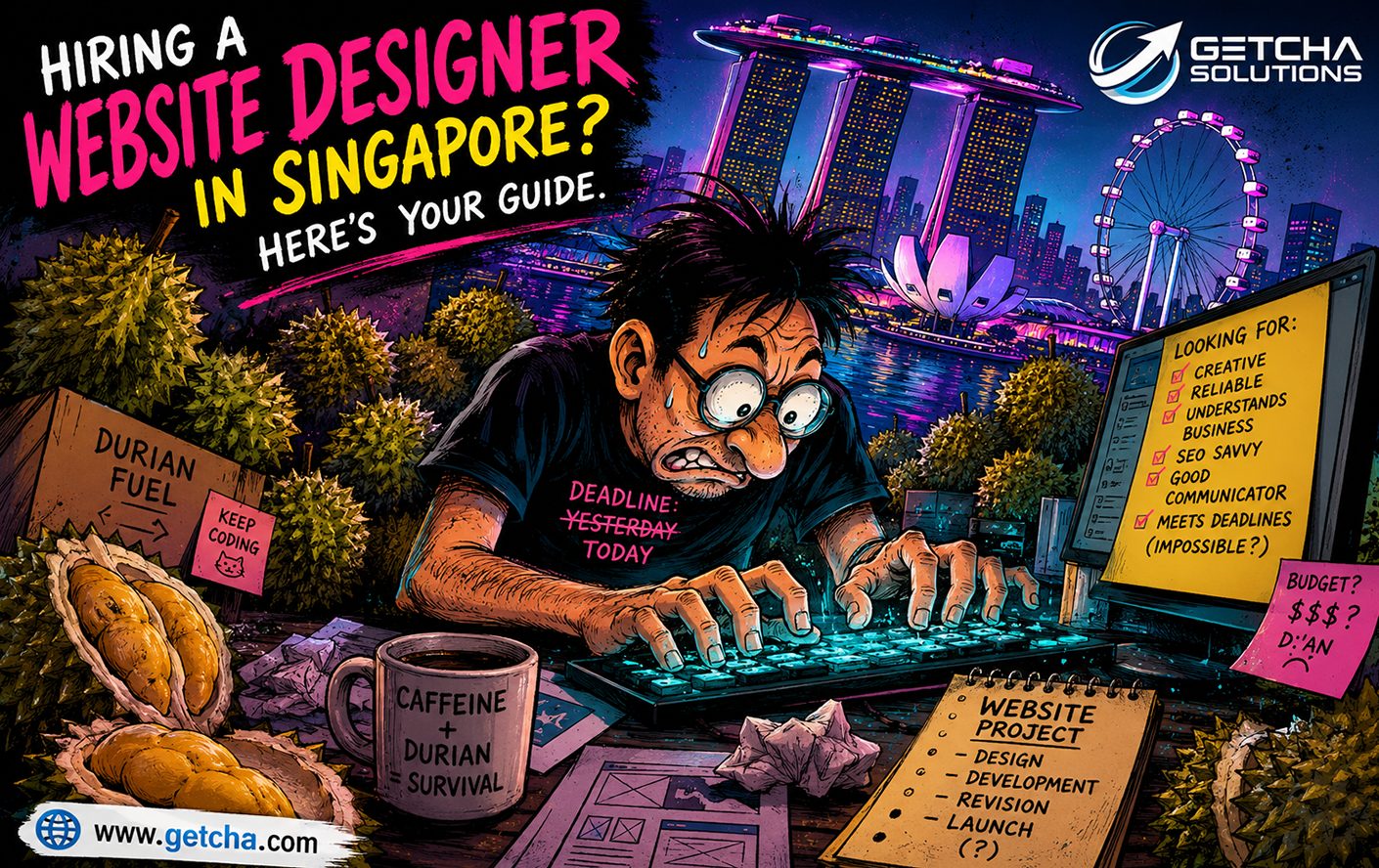
- Unclear requirements are the Cyclops of web development: one big problem that sees only one part of the project.
- Shiny tools, cheap templates, plugins and AI builders can help, but only when guided by proper business structure.
- Server, hosting, SSL, email delivery and technical SEO problems are not small details. They can sink the whole ship.
- A good Singapore web developer acts like a navigator: planning the route, avoiding monsters and bringing the business goal home.
Every website project starts very innocently.
Someone says, "Anees, we just need a simple website."
This sentence is the modern equivalent of Odysseus saying, "I am just going home after the Trojan War." Sounds straightforward. Pack bag, board ship, reach home, eat dinner. Settled.
Then suddenly, the sea gets angry, monsters appear, the crew gets lost, strange islands emerge, and somebody probably says, "Can add one small feature?"
As a web developer in Singapore who has been building websites, web apps, mobile apps, CRM systems and custom business software for many years, I can confirm one thing: every serious digital project has its own odyssey.
Sometimes the journey is smooth. Sometimes it is heroic. Sometimes it is just me staring at a server error at 1.17am wondering whether Poseidon has personally taken offence to PHP.
But whether you are a business owner planning a new website, a company trying to fix an old WordPress site, or an SME thinking of building a custom CRM system, there are useful lessons from The Odyssey. Not the "wear armour and fight sea monsters" kind. More like: plan properly, do not trust every shiny thing, respect hidden danger, and always know where home is.
In website terms, "home" is not just your homepage. It is your business goal: more enquiries, more trust, better lead flow, cleaner workflow, less chaos, and fewer "bro, the form not working again" messages.
If your website journey already feels like a Greek epic
Send us your website, old system or rough idea. We will help you see whether it needs redesign, rescue, SEO/AEO cleanup, WordPress support or a clearer digital journey.
Send us your websiteThe journey is never "just a website"
When business owners contact Getcha Solutions, many start with one simple request.
"We need a website."
Then we talk a bit more. Actually, they need a website that explains their services clearly. They need contact forms that work. They need WhatsApp buttons. They need SEO structure. They need mobile-friendly pages. They need fast loading. They need technical SEO. They need trust signals. They need their website to show up properly when shared on Facebook, WhatsApp and LinkedIn. They need Google and AI search tools to understand what they do.
Sometimes, they also need a CRM because the leads from the website are going into Excel, WhatsApp, memory, vibes and prayer.
This is where the odyssey begins.
A proper website development project is not only about putting text and images on a page. Any tool can do that now. Even AI can generate a page that looks impressive for about five minutes, until you ask where the enquiry goes, who receives the email, how the content is structured, whether the page is indexed, whether the form is secure, and whether the business owner can actually use it.
Then suddenly the magic smoke disappears.
A business website is a journey from visitor confusion to visitor action. The job of a web developer is to design that journey properly. If the visitor lands on your site and has to think, "What does this company actually do ah?", your website has already started rowing in circles.
The Cyclops: unclear requirements with one big eye
In The Odyssey, Odysseus meets the Cyclops. One giant eye. Very powerful. Very scary. Not exactly customer-service oriented.
In web development, the Cyclops is usually unclear requirements.
It sees only one thing.
"I want the homepage to look nice."
"I want the button bigger."
"I want something modern."
"I want like Apple website."
Okay, can. But what must the website actually achieve?
A good web developer cannot only look at one part. We need to see the whole cave. Who is the target customer? What services are most profitable? What action should visitors take? Is the business targeting Singapore SMEs, homeowners, tuition parents, clinic patients, B2B buyers, or someone else? Should the lead go to email, WhatsApp, CRM, or an admin dashboard? Is the website meant for trust, direct enquiries, SEO traffic, AI search visibility, or all of the above?
If you only design for "nice", you may end up with a beautiful cave and still get eaten.
For Singapore businesses, especially SMEs, clarity matters more than decoration. Visitors are busy. They are checking your site between meetings, MRT rides, lunch breaks and WhatsApp messages from suppliers. If your website does not explain your value quickly, they leave.
Before starting any website project, write down the top three actions you want visitors to take. Maybe it is "WhatsApp us for a quote", "submit the contact form" and "view our completed projects". That simple exercise already prevents many monsters from appearing later.
The Sirens: shiny tools that sing very sweetly
The Sirens in The Odyssey sing beautifully and lure sailors into danger.
Today, the Sirens are called no-code builders, cheap templates, random plugins, AI website generators, and that one person who says, "Actually can do very fast one."
To be fair, these tools are not bad. Some are useful. We also use modern tools, frameworks and AI-assisted workflows where appropriate. The problem is not the tool. The problem is blindly trusting the tool without understanding the business logic.
A WordPress plugin may promise to solve everything. Then you install one more plugin. Then another. Then another. Contact form plugin. SEO plugin. Cache plugin. Security plugin. WhatsApp plugin. Popup plugin. Slider plugin. Backup plugin. Plugin to manage plugins. Plugin to emotionally support other plugins.
After a while, your WordPress site becomes less like a website and more like a family gathering where everyone is talking at the same time.
Then one update breaks the form. Another update slows the site. A plugin conflict causes a blank page. The SSL warning appears. The business owner panics. The developer receives the message: "Bro, I didn't touch anything."
This is the traditional opening ceremony of a WordPress rescue mission.
The lesson is simple: shiny tools are useful only when guided by proper structure. If you are using WordPress, keep plugins minimal, updated and necessary. If your business process is complex, consider whether you need a custom web app or CRM instead of forcing everything into plugins.
Sometimes, the cheapest tool becomes expensive because you spend months working around its limitations. Very budget-friendly. Until it is not.
If your WordPress site is already behaving strangely, start with the free WordPress SOS guide before clicking random update buttons like a brave but slightly reckless sailor.
Poseidon: server problems have a sense of drama
In the myth, Poseidon makes Odysseus's journey difficult by sending storms.
In web development, Poseidon is the server.
Hosting issues. DNS problems. Email delivery failures. SSL certificates. PHP version mismatch. File permissions. Database errors. Random 500 Internal Server Error. Cron jobs doing mysterious things. Cache showing old content. Facebook sharing the wrong image. Google indexing the wrong URL.
The server does not care that you have a meeting at 10am.
It will choose 9.43am to misbehave.
Over the years, we have handled many website and system problems where the issue was not the design at all. The problem was hidden in hosting, server configuration, old code, outdated libraries, bad redirects, missing canonical tags, oversized images, broken forms, or poor technical SEO.
This is why a web developer is not just someone who "makes pages". A proper developer needs to understand enough of the full stack to know where the storm is coming from.
For business owners, the practical takeaway is this: do not treat hosting, backups, email and technical SEO as boring afterthoughts. These are the ship. If the ship leaks, the hero speech is not going to help.
The real destination is not the homepage
Odysseus wanted to return to Ithaca. That was the destination.
For a business website, the destination is not "launch website". Launching is not the victory. Launching is just leaving the harbour.
The real destination is business outcome.
Does the website bring enquiries? Does it explain your services clearly? Does it build trust? Does it help Google understand your pages? Can AI search tools understand what your business does? Does the contact form work? Does WhatsApp open properly? Are the important pages linked internally? Are visitors guided from curiosity to action?
A website that looks nice but does not generate enquiries is like a very beautiful boat parked in the wrong ocean.
For Singapore SMEs, this matters even more because many businesses do not have large marketing teams. The website must do more work. It must explain, persuade, reassure and guide.
That is why we think about websites together with SEO, AEO, AI search readiness, service positioning, lead capture and sometimes CRM workflow. A visitor should not just see your website. The visitor should understand you. Search engines should understand you. AI tools should understand you.
Your future customer should be able to say, "Okay, this company can help me."
That is the Ithaca moment.
Every business website needs a map
In The Odyssey, getting lost is basically the whole plot.
On a website, getting lost is bad user experience.
A visitor lands on your homepage. What happens next?
Do they see what you do within a few seconds? Can they find your services? Can they see proof? Can they contact you easily? Is your menu clear? Are your pages connected properly? Do your blog articles link naturally to your services? Does your portfolio support your claims?
A good website needs a map.
Not a literal map, unless you are showing your office location. I mean a journey map: homepage to service page, service page to proof, proof to contact, blog article to related service, FAQ to enquiry, case study to consultation, free guide to email list. Every page should help the visitor move somewhere useful.
This is also important for SEO and AEO. Google and AI systems do not only read individual pages. They also observe structure, relationships, clarity and context. If your site is a messy island chain with no bridges, do not be surprised if search engines and AI assistants choose someone else's clearer website.
Harsh? Yes.
True? Also yes. Internet no sentiment one.
Some projects are rescue missions
Not every digital journey starts fresh.
Sometimes we are called in when the ship is already half-sinking.
The old developer disappeared. The website is broken. The WordPress admin is confusing. The contact form is not sending. The site is slow. The hosting details are unclear. The project was built halfway and abandoned. The business owner is tired. The staff are using Excel because the system cannot be trusted.
These are project rescue situations.
In such cases, the first step is not to rush in and start changing everything. That is how you turn a small fire into a festival.
The first step is to understand what exists. What is broken? What is risky? What can be saved? What should be rebuilt? Where is the database? Are there backups? Which pages are indexed? What business process does this support? Is the current structure worth fixing, or is a cleaner rebuild better?
A good web developer must know when to repair and when to say, "This one, better do not pretend. Rebuild properly."
That honesty is important. Because sometimes the most expensive thing is not building new. It is continuing to patch a broken system that nobody understands anymore.
AI is helpful, but it is not Athena
In The Odyssey, Athena helps Odysseus with wisdom and guidance.
Today, people sometimes treat AI like Athena, Oracle, intern, developer, designer, project manager and magician combined.
AI is useful. Very useful, actually. We use AI for planning, content ideas, code assistance, debugging support, workflow thinking and productivity. But AI still needs direction.
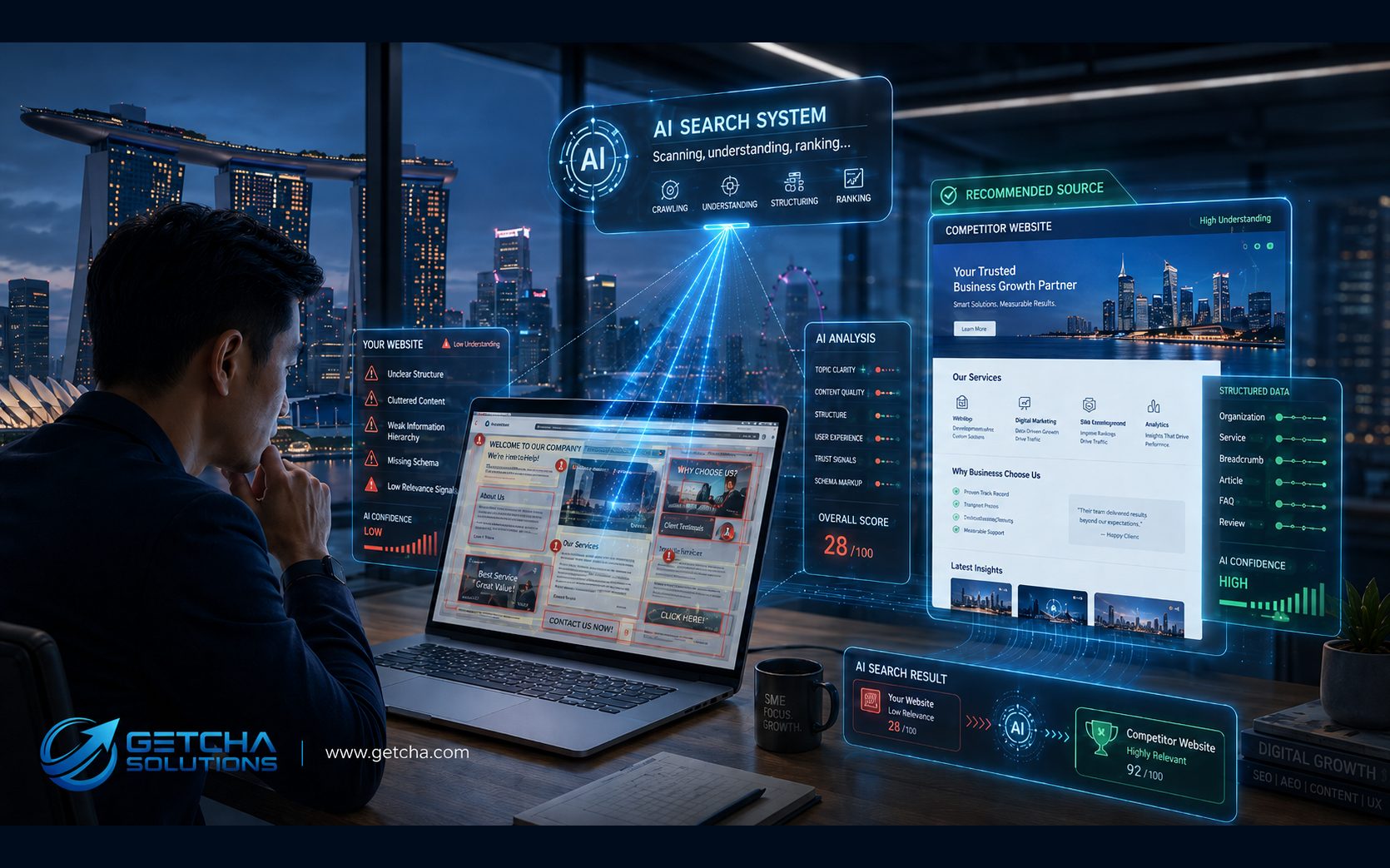
If your website has unclear services, poor structure, vague content and missing business logic, AI cannot magically understand your company. It may summarize you wrongly. Worse, it may recommend your competitor because their website is clearer.
This is where AEO, GEO and AI search readiness become important. Your website should answer real customer questions clearly. It should explain your services in plain language. It should have structured pages, proper headings, internal links, FAQs, case studies, reviews, contact details and useful content. Your blog should not just exist for decoration. It should help humans, Google and AI systems understand your expertise.
For a Singapore web developer or software developer, this is now part of the job. We are not only building websites for browsers. We are building websites for people, search engines and AI assistants.
Welcome to the future. Still got bugs, but got better lighting.
What business owners can learn from this
If you are a business owner planning a website, web app, mobile app, CRM system or custom software project, here is the practical lesson: do not start with the tool.
Start with the journey.
Ask what your customer needs to understand. Ask what action they should take. Ask what information your team needs to manage. Ask where enquiries go after submission. Ask how you will follow up. Ask what pages Google should index. Ask what AI search tools should understand about your business.
Then choose the right technology.
Maybe it is a website. Maybe it is WordPress. Maybe it is a custom PHP system. Maybe it is a CRM. Maybe it is a dashboard. Maybe it is an AI-assisted workflow. Maybe it is a simple landing page with a strong WhatsApp enquiry flow.
Not every business needs a giant system. But every business needs clarity. If the business process is simple, keep it simple. If the business process is complex, do not squeeze it into a toy boat and hope it survives the sea.
The developer is the navigator
After many years in this field, I have realized that clients usually do not only need a coder.
They need a navigator.
Someone who can say, "This is the safest path." Someone who can explain technical issues in human language. Someone who can look at a website and see not just pixels, but business flow. Someone who understands that a contact form failing silently is not a small issue. It is lost money wearing an invisibility cloak.
Someone who can help a Singapore SME move from messy ideas to a working system.
That is how we try to position Getcha Solutions. Not just as people who build websites, apps and software, but as a practical digital team that helps businesses get from confusion to clarity.
The odyssey may still have waves. But at least there is a map, a ship, a compass and someone awake at the wheel. Preferably with coffee.
Your website should bring customers home
The reason The Odyssey still works as a story is simple. It is about the long, difficult journey back to what matters.
A business website is also like that.
Your visitor starts somewhere outside your world. They search Google. They click a link. They see your page. They wonder if they can trust you. They compare you with others. They decide whether to contact you.
Your job is to bring them home.
Not to confuse them. Not to impress them with unnecessary drama. Not to trap them in a maze of vague pages and broken buttons.
Bring them to clarity. Bring them to trust. Bring them to action.
If your website, WordPress site, CRM system or custom software project feels like its own Odyssey, maybe it is time to get a proper navigator.
Send us your website or idea. We will help you see whether you need a redesign, rescue work, SEO/AEO cleanup, WordPress support, a custom CRM, or simply a clearer digital journey before the next monster appears.
And if your website has already angered Poseidon, please do not keep clicking random plugin updates.
That is not bravery. That is how legends become support tickets.
Common questions about this topic.
What can The Odyssey teach business owners about websites?
The biggest lesson is that every journey needs a clear destination and a proper guide. A business website should guide visitors from first impression to trust, enquiry and action. Without structure, even a beautiful website can feel confusing.
Why is website planning important before development?
Website planning helps define your target audience, service positioning, content structure, enquiry flow, SEO keywords, internal links and conversion goals. Without planning, the project may look nice but fail to generate leads or support the business properly.
Should Singapore SMEs use WordPress or custom web development?
WordPress can be useful for simpler websites, especially when maintained properly. But if your business needs custom workflows, CRM features, dashboards, booking systems, automation or complex admin controls, custom web development may be a better long-term fit.
What is project rescue in web development?
Project rescue means reviewing and fixing an existing website, web app or software project that is broken, abandoned, slow, insecure or difficult to maintain. The goal is to decide whether to repair, stabilize, migrate or rebuild the system safely.
How can a website become AI-search ready?
A website becomes more AI-search ready when its content is clear, structured and useful. This includes strong service pages, FAQs, case studies, internal links, schema markup, accurate contact details, clear headings and content that answers real customer questions.
Why do business websites need more than good design?
Good design helps, but a business website also needs speed, mobile usability, SEO, clear copywriting, working forms, WhatsApp links, trust signals, analytics, technical stability and a proper conversion path. Nice visuals alone do not guarantee enquiries.
How can Getcha Solutions help with website or software projects?
Getcha Solutions helps Singapore businesses with website development, web apps, mobile apps, custom CRM systems, AI-assisted workflows, WordPress support, project rescue, SEO/AEO improvements and practical digital systems built around real business operations.